
Nature calls
And we must answer

Reconstruction continues apace in my new-old house and we are at the point now where the professionals have arrived, and I am left with filling up contractor bags with trash.
It’s OK. I’m pretty good at it.
Yesterday, I was dragging debris from the backyard to the front so Jason, the guy with the truck, could take it all away. He’s already removed a load that weighed just shy of a ton. This is an even bigger load but via text, Jason suggests he can play Tetris and make it all fit. I suggest I’ll videotape it and tell all my friends, if he does.
How can such a small house generate so much trash? I’d post a photo but it’s horrifying that the hedge in front of my house is made of fencing, posts, and garden-variety debris. The neighbors have been unfailingly polite, but yeesh.
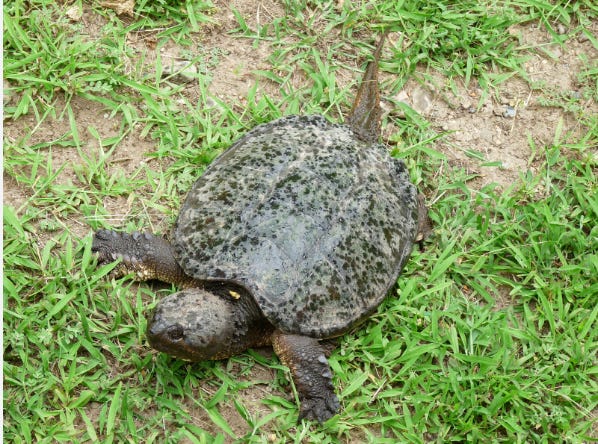
Along about mid-afternoon, I went to throw a post onto the pile and nearly stepped on what I thought was a piece of moss-colored trash I hadn’t thrown far enough, but nope. It was a snapping turtle. A big one.
The discovery of a snapping turtle is news that must be shared, so I ran in to tell the men working on the kitchen that I’d just seen this prehistoric tortuga, and suddenly, we three were all 8 years old. One of the men stayed on task, and the other came out with me, put his hand over his mouth at the size of the thing, and said quietly that the turtle needed to go back into the water. Of course he was right. He and I discussed this only briefly, and since I had gloves on, I said I’d do it.
Turtles, when provoked, actually move pretty fast, and as soon as I touched its shell, this one shot under the trash hedge. We managed to get the thing out from under the wire fencing, and I bent to pick it up to get it across the street to the lake.
Reader, do not let cartoon turtles confuse you. This one did not want me to carry it, and it proceeded to try to claw the bejesus out of me. One claw made contact with my arm, and I dropped the thing, hard, on the street.
A smart person would have stepped back and assumed the turtle could figure out how to get out of the road, but I am not that person. Instead, I picked it up again, and got it across the street on a dead run. I was trying to calm it down with soothing tones, but that didn’t much help and I didn’t much mean it, anyway.
Right then, a guy named Eddy, Who Knows Turtles, pulled his truck over and showed me how to pick the thing up (toward the back of the shell where the flailing claws can’t touch you, plus you should hold the turtle vertical, head up). It made the weirdest grunting sound, but we walked it to the lake and then watched it swim away.
This is egg-laying season, Eddy said, and I have no reason to doubt him. I should wash that cut, he said, and I did though it is pretty superficial and hard to distinguish among all the other cuts on my arms. He said he once accidentally shot a turtle with an arrow, and a few days later, found the thing with the unbroken-off arrow still in it, still alive. That put him on the path to learn everything he could about the species.
I never knew there was that much to know, but yesterday was a good day because I learned something: Turtles are assholes.
No sympathy from me. These prehistoric beings owned their territories long before we usurped them. Every year they journey to their ancestral birthing grounds, laboriously negotiating whatever new barriers we humans have created, such as multi-lane roads, fences, homes, etc. They operate entirely on their internal maps, which do not include us. They dig pits and lay their eggs - an exhausting process - cover them up, and return to their watery homes, having to re-negotiate the deathtraps we have created.
They may look armored, but they are vulnerable in so many ways. And when injured, they die as slowly as they move, suffering horribly (this according to the dedicated turtle rehabbers I visited at their clinic on Sanibel Island.)
If we encounter turtles of any kind during their spring journeys, we should let them be unless they are in danger, such as crossing a road. ALWAYS assist a turtle in continuing in the direction in which it was headed. Never try to relocate it. They do not "transplant" to new habitats. A snow shovel can be helpful as long as it is used gently so that the softer belly plate is is not damaged. Attempting to pick up a Snapper by its tail will fatally injure it.
Because there are so many predators that find turtle eggs delicious, few will finally hatch and even fewer tiny young will succeed in making the often dangerous journey to their water homes.
Our biggest problem with turtles is that we do not have the mercy or the patience required to let them live at their own speed, following their own ancient paths. End of lecture.
How would you feel if a giant picked you up under your armpits and started taking you somewhere!